CGMs vs. Fingersticks in 2026: A Guide for Haskell Patients
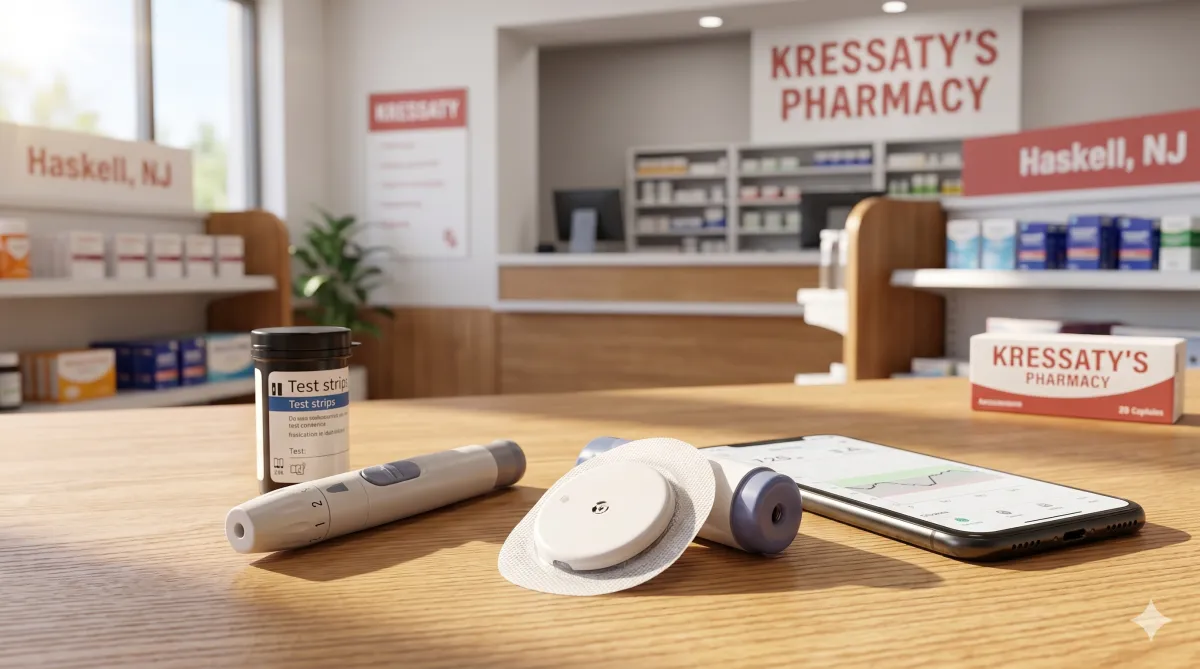
I have seen thousands of boxes of test strips pass over our counter at 1068 Ringwood Ave. For decades, the fingerstick was the only way to get a glimpse into your blood sugar. It was a snapshot: a single moment in time captured with a prick and a drop of blood. But as we move through 2026, the conversation in our community has shifted. More of my neighbors are coming in with small, white circles on their arms, looking at their phones instead of their lancets.
The rise of the Continuous Glucose Monitor (CGM) has fundamentally changed how we manage diabetes in Haskell. However, with new options like the Dexcom G7, the FreeStyle Libre 3 Plus, and even over-the-counter sensors like the Dexcom Stelo hitting our shelves, the confusion is at an all-time high. I want to help you cut through the noise and figure out which tool actually belongs in your daily life.
The Continuous Advantage: Why Haskell is Going Digital in 2026
The biggest reason patients are asking for a CGM, as Haskell, NJ residents can rely on, is for the "movie" rather than the "snapshot." A traditional meter tells you where you are right now. A CGM tells you where you are, where you were twenty minutes ago, and most importantly, where you are heading.
In 2026, we are looking at diabetes technology 2026 standards that prioritize Time-in-Range (TIR). This metric tells us what percentage of the day you are staying between 70 and 180 mg/dL. A fingerstick cannot tell you if you dropped into a dangerous low while you were sleeping or if that pasta dinner caused a massive spike two hours later. The CGM reveals those hidden patterns, providing a level of safety and peace of mind that a manual check simply cannot match.
The Reality Check: Is the Traditional Meter Obsolete?
Despite the bells and whistles of the latest sensors, I always tell my patients on Ringwood Ave: do not throw away your traditional meter just yet. There is a physiological reality we have to respect called "lag time."
A fingerstick measures capillary blood: the "real-time" sugar in your system. A CGM measures interstitial fluid, which is the fluid surrounding your cells. Because it takes time for sugar to move from your blood into that fluid, the number on your CGM can be 5 to 15 minutes behind your actual blood sugar. During rapid changes, like after a workout or a high-carb meal, your sensor might say you are 120 while your blood is actually 150. For medical decisions like dosing insulin or treating a severe low, that fingerstick remains the gold standard for accuracy.
CGM vs. Fingerstick: Breaking Down the Key Differences
When choosing a glucose monitor pharmacy that Haskell families can trust, it helps to see the trade-offs side by side.
Frequency of Data: A fingerstick is done on-demand (maybe 4 times a day). A CGM provides up to 288 readings every 24 hours.
Convenience: The CGM is applied once every 10 to 15 days. Fingersticks require a new prick for every single reading.
Cost and Access: While insurance coverage for CGMs has expanded greatly in 2026, traditional meters and strips are still the most affordable entry point for those without comprehensive coverage.
Alerts and Safety: CGMs can beep or vibrate to wake you up if you go low at night. A manual meter is silent and requires you to be awake and proactive.
Local Pharmacy Diabetes Support: Finding the Right Path on Ringwood Ave
Choosing a device isn't just about reading a brochure; it is about how that device fits into your life. Do you spend your weekends hiking in Norvin Green? You might need a sensor with a stronger adhesive. Are you a senior who isn't comfortable with smartphone apps? You might prefer a traditional meter or a CGM with a dedicated receiver.
This is where local pharmacy diabetes support makes the difference. We don't just hand you a box. We help you navigate the insurance hurdles, show you how to apply the sensor for the first time, and help you interpret the "arrows" that can sometimes feel overwhelming. We are here to ensure that the technology works for you, not the other way around.
FAQs
Is a CGM more accurate than a fingerstick in 2026?
Accuracy is measured by MARD (Mean Absolute Relative Difference). Modern CGMs like the Dexcom G7 have an MARD of around 8.2%, which is excellent. However, a fingerstick is still more "immediate." If your symptoms do not match your CGM reading (for example, you feel dizzy but your sensor says you are 100), you should always verify with a fingerstick.
+1
Does insurance cover CGMs at Kressatys Pharmacy?
In 2026, most commercial plans and Medicare Part B cover CGMs for patients who use insulin or have a history of hypoglycemia. We can run a benefits check for you right here at 1068 Ringwood Ave to tell you exactly what your out-of-pocket cost will be.
Can I get a glucose monitor without a prescription?
Yes, in 2026, there are now FDA-cleared over-the-counter (OTC) CGMs like the Dexcom Stelo and the FreeStyle Libre Rio. These are generally designed for people with Type 2 diabetes who do not use insulin but want to track their health and lifestyle impacts.
Why do my CGM and fingerstick readings never match perfectly?
Because they measure different fluids (interstitial fluid vs. capillary blood). It is normal for them to be 10 to 20 percent apart. Think of it like a roller coaster: the fingerstick is the front car and the CGM is the back car. They are on the same track, but the CGM sees the loop a few minutes after the front car does.
Conclusion: A Personalized Plan for Your Health
The best way to monitor your sugar isn't necessarily the most expensive or the newest: it is the one you will actually use. Whether you prefer the simplicity of a traditional meter or the high-tech insights of a 2026 sensor, the goal remains the same: staying healthy and feeling your best in our Haskell community.
We invite you to stop by and let's have a conversation about your goals. We will look at your history, your lifestyle, and your insurance to find the perfect fit. You don't have to navigate the world of diabetes technology alone.
Your Neighbors at Kressatys Pharmacy
Ready to upgrade your monitoring? Stop by and see us at 1068 Ringwood Ave #1, Haskell, NJ 07420 or call us at (973) 835-1627 today. Let’s find the right tool to help you stay in range and live your best life.
